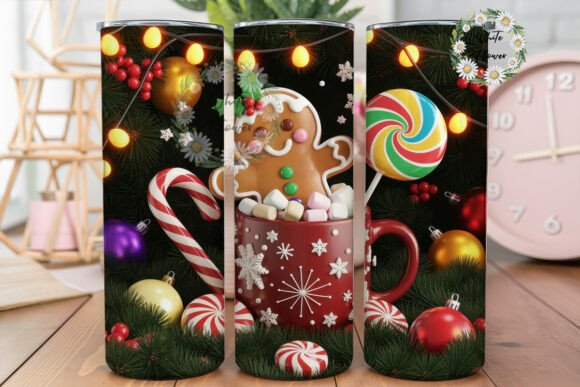
Gingerbread Mug Festive 20oz Wrap
When a holiday design lands in my inbox, I instantly look for that warm, handmade feel. The Gingerbread Mug Festive 20oz Wrap caught my eye because it’s cozy without being overly cute. The gingerbread mug illustration, the soft wintery accents, and the clean layout make it feel like something you’d find on a boutique sweatshirt or a premium kitchen towel. But as an embroidery designer, I don’t just admire the graphic. I immediately start picturing stitch paths, thread choices, and which hoop will handle the placement.
This is a digital graphic file, not a stitch-ready embroidery file. It comes in a high-resolution 300 DPI format, so every sprinkle and icing line stays crisp. You’ll get one straight version and one tapered version, both sized to 9.3 inches by 8.2 inches. The design is not seamless, so you won’t be repeating it around a garment. That’s actually a plus for embroidery, because a centered statement piece often looks more intentional. The watermark-free file is clean, and that’s essential if you’re planning to digitize it for machine embroidery projects or use it as a mockup template for your shop.
First stitch impressions: warmth, personality, and the right kind of detail
There’s a lot of personality packed into this mug. The gingerbread figure has a little smile, frosting swirls, and a peppermint accent that read clearly even at a glance. The layout feels balanced, with the mug centered and the holiday elements framing it. From an embroidery perspective, this matters because a design that’s too busy can turn into a dense, puckered mess. Here, the shapes are defined enough for satin stitch outlines, and the larger areas could translate beautifully into fill stitch without overwhelming a medium-weight fabric.
I could already see this on a tote bag design for a small craft fair. Picture a natural canvas tote with the gingerbread mug stitched in warm browns, cream, and a pop of red, maybe with a subtle textured running stitch for the steam. The straight graphic file gives you a clean rectangle to work with, so you can map it into embroidery software and adjust the size to fit a 5x7 or 8x12 hoop, depending on your machine. The tapered version might be a bit tricky for standard embroidery, but it’s handy if you’re placing the design on a slightly curved surface like a cap or a sweatshirt yoke, where a straight edge sometimes looks static.
Real-life scenario: a holiday tote that sells itself
Last week I was prepping samples for a client who runs a small handmade shop. She wanted something festive for personalized gifts but nothing that screamed mass-produced. We tested a few graphics, and the Gingerbread Mug Festive 20oz Wrap was the one that felt like a real conversation starter. I digitized the straight version, simplified a few tiny icing dots to avoid excessive stitch density, and stitched it on a heavy cotton tote with a medium cutaway stabilizer. The result was a clean, cheerful embroidery that looked like it belonged in a high-end holiday collection.
Customers at her pop-up grabbed the totes immediately. The design was recognizable from a distance, and the gingerbread theme triggered that nostalgic, hygge feeling. From a business perspective, that’s the sweet spot. You want a handmade product that photographs well, stands out in an Etsy listing, and doesn’t require hours of thread changes. This graphic, once digitized, translated into a relatively quick stitch with a few well-chosen thread colors — warm ginger, cream, burgundy, and a touch of mint green for the peppermint.
Where this design performs best — and where it needs a little caution
I wouldn’t force this onto every product. The design’s strength is in flat or gently curved surfaces. It shines on:
- Tote bags and canvas pouches
- Sweatshirt embroidery (front or back placements)
- Pillow covers and tea towels
- Aprons and kitchen linens
- Patch-style sewing on denim jackets
- Baby blankets and nursery decor
On the other hand, I’d be cautious with stretchy fabric like thin t-shirts, unless you’re using a high-quality fusible stabilizer and testing the pull compensation. The design is not tiny, so if you’re working with a small hoop size, you’ll need to scale it down. That’s where the 300 DPI resolution helps — you can reduce the graphic without losing detail before digitizing. But if you shrink it too much, those tiny peppermint swirls and icing dots might become muddy or require a running stitch simplification. Always run a test on scrap fabric first.
Dark fabric is another consideration. The gingerbread itself is brown, so on a black or navy background, you’ll need to adjust thread colors for contrast. A cream outline or a light fill behind the mug can make the whole design pop. This is something I often test in black-and-white mockups before committing thread to fabric. Printable mockup use is another way this graphic file helps — you can place it on product photos to see how the contrast works before you ever stitch a single thread.
Thinking like a small business owner: value, versatility, and customer trust
When you’re selling custom apparel or embroidery project kits, the design you choose directly affects how buyers perceive your brand. The Gingerbread Mug Festive 20oz Wrap falls into that sweet category of seasonal but not disposable. It’s not just for Christmas; it carries a winter coziness that works from November through February. That means your craft business can offer it as a limited-edition item without the design feeling stale by January 2nd.
For Etsy sellers and small shop product owners, the fact that you get both a straight and a tapered file gives you flexibility. I’ve used the straight version for flat embroidery digitizing, and the tapered one for creating sublimation mug wraps that match embroidered coasters. That kind of coordination across products builds a cohesive brand. If a customer buys a mug with the tapered design, then sees a matching embroidered pillow cover, the perceived value skyrockets.
Licensing is critical here. The file is free of watermarks, but that doesn’t automatically mean it’s cleared for commercial embroidery. Before you digitize and sell finished items, confirm the usage rights. Many graphic designers allow personal and small commercial use, but you’ll want to double-check if you’re putting it on hundreds of products or selling the digital embroidery file you create from it. This is a step I never skip, because a polite license check can save you from a messy takedown later.
Digitizing notes every embroidery designer should consider
If you’re converting this graphic into a machine embroidery design, here’s what I’d keep on my checklist:
- Stitch density: the mug body is large. Use a light fill stitch with a density of 0.4–0.5mm to avoid stiffness. Over-dense embroidery on a tote or sweatshirt can feel like a board.
- Thread colors: stick to 4–6 colors. More than that, and you’ll spend too much time changing threads. That peppermint accent can be a single color with a satin stitch outline.
- Hoop size: the full 9.3 x 8.2 inch design may need a large hoop. If you’re using a 5x7 or 6x10, scale it down proportionally and test the smallest details.
- Stabilizer: for woven fabrics, a medium cutaway stabilizer works. For knits, add a fusible mesh to prevent shifting.
- Small details: the icing dots and sprinkles might become too tiny when scaled. I usually replace clusters of dots with a few single stitches or a small applique design element to keep the handmade charm.
I also recommend testing the design on a fabric texture similar to your final product. A looped terry towel, for example, will swallow fine details differently than a smooth cotton tote. A quick test stitch on a scrap of the same fabric will show you whether you need to increase the pull compensation or add a basting box.
How it fits into a holiday product lineup
Imagine you’re building a small collection of holiday embroidery items. You’ve got a snowflake beanie, a reindeer baby onesie, and now a gingerbread mug tote. The Gingerbread Mug Festive 20oz Wrap ties the whole theme together because it’s food-and-drink centered, which is universally appealing. It works for baby embroidery (a onesie with a tiny mug and “Baby’s First Christmas”), kitchen towel sets, and even apron pockets. The design is friendly, not childish, so it appeals to adult customers who want a subtle festive touch.
If you’re a digital product seller who offers embroidery-ready mockups, this graphic is a great asset. You can place it on a virtual sweatshirt, show the straight and tapered variations, and let customers see the scale. Since it’s a high-resolution design asset, the mockup looks professional and helps buyers understand the final embroidered product without needing to imagine the stitch texture.
Final thoughts from a stitcher’s perspective
I’ve been around long enough to know that not every pretty graphic makes a good embroidery design. But the Gingerbread Mug Festive 20oz Wrap has the right bones. The balance of open space and detail, the clear focal point, and the holiday mood all translate well when you treat it with a thoughtful digitizing hand. It’s not an embroidery file out of the box, so you’ll need to put in the work to convert it. But if you’re comfortable with embroidery software, or you work with a digitizer, this is a solid foundation for a finished product that feels handmade and high quality.
For commercial embroidery uses, just remember to check your license before you list that baby blanket or tote bag. And always, always test on scrap fabric. When I did, I ended up with a tote that my client’s customers kept reaching for — and that’s the real proof that a design works.