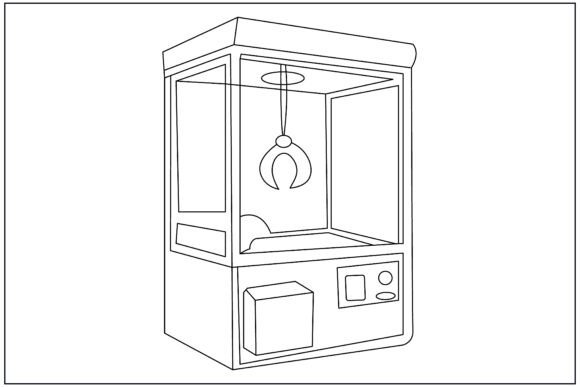
Prize Claw Machine Line Art: Graphics & Illustrations for Playful Branding
As a graphic designer who’s built brand identities for indie toy shops, retro-themed cafés, and seasonal pop-up markets, I recently evaluated Prize Claw Machine Line Art for a real client project: a limited-edition summer campaign for a handmade candy brand launching “Claw & Conquer” gummy bundles. My goal wasn’t just to see if it looked cute—it was to assess whether this illustration could carry weight in commercial design, support visual storytelling, and hold up across packaging, social media, and physical merch without diluting brand clarity.
First Impression: Nostalgic, Clean, and Instantly Readable
The moment I opened the vector file, I noticed how efficiently the line work balances simplicity and character. It’s not overly detailed—no shading, no gradients—but the proportions of the claw arm, the tilted prize basket, and the subtle curvature of the glass dome all suggest motion and playfulness. This isn’t cartoonish clutter; it’s confident minimalism with personality. The mood is upbeat, slightly mischievous, and warmly nostalgic—think 90s arcades meets modern craft sensibility. That makes it ideal for clients whose audience values authenticity, tactile charm, and lighthearted engagement—especially handmade businesses, Etsy sellers, and small-batch product lines targeting Gen Z and millennial shoppers.
Where It Shines: Real-World Design Applications
Prize Claw Machine Line Art performs exceptionally well in contexts where visual tone matters more than technical precision. As a graphic design asset, it adds instant thematic cohesion to:
- Packaging design: Perfect for die-cut sticker accents on candy boxes or as a repeating border on hang tags—its clean lines scale beautifully from 1" labels to 8" side panels.
- Social media graphics: Works as a central motif in Instagram carousels or Pinterest pins when paired with bold sans serif type (think Montserrat Bold or Poppins SemiBold) and high-contrast backgrounds.
- Printable design and product mockups: I dropped it into Canva templates for tote bag and mug previews—and it held its own against realistic textures without competing for attention.
- Cricut project and sublimation design: The crisp SVG paths cut cleanly on vinyl and transfer smoothly onto ceramic and fabric surfaces.
- Editorial design and marketing visuals: Used as a decorative divider in digital lookbooks or as a subtle watermark behind light-colored text blocks.
It also integrates seamlessly into themed collections—imagine pairing it with other arcade-inspired illustrations (tickets, tokens, pixel hearts) to build a cohesive design bundle for an Etsy shop or print-on-demand store.
Where to Use It Thoughtfully
This isn’t a universal drop-in solution. Its expressive silhouette works best when given breathing room. Avoid using Prize Claw Machine Line Art in:
- Small-scale applications under 0.5" tall—fine details like the claw’s joint or the basket weave risk blurring or disappearing.
- Crowded layouts with dense typography or layered photo backgrounds—its charm gets lost without contrast and isolation.
- Minimalist branding systems that rely on ultra-refined geometry or monoline neutrality—it introduces warmth but sacrifices austerity.
- Corporate or B2B materials where visual trust hinges on restraint and authority—this leans joyful, not judicial.
In those cases, it’s better deployed as a secondary creative design element—not a primary logo or core identity mark—unless the brand voice explicitly embraces whimsy and interactivity.
Designer Notes: What to Test Before Client Delivery
Before locking it into any final commercial design, here’s my checklist:
- Test in black and white: Confirmed—no detail vanishes when desaturated. Strong silhouette integrity.
- Check contrast on both light and dark backgrounds—I used it over charcoal matte paper mockups and bright kraft cardstock. Works cleanly in both.
- Preview at multiple sizes: At 3x zoom in Illustrator, anchor points remain smooth; no jagged edges or stray nodes.
- Place on real mockups: Verified sharpness on ceramic mug, cotton tote, and matte poster prints—no anti-aliasing issues.
- Review file formats: ZIP includes SVG, PNG (transparent), and EPS—ideal for flexibility across web, print, and cutting machines.
- Inspect transparency: PNG has clean alpha channel—no fringing or halo artifacts.
- Pair with fonts: Looks dynamic with geometric sans serifs (e.g., Inter), friendly rounded displays (e.g., Quicksand), and even subtle script accents (e.g., Pacifico for subheadings). Avoid thin serifs—they clash tonally.
- Confirm commercial license: Yes—explicitly permits use in client projects, merchandise, and digital products including Etsy listings and print-on-demand platforms.
Final Verdict: A Strategic Creative Asset, Not Just Clipart
Prize Claw Machine Line Art stands out because it bridges aesthetic appeal and functional versatility. It doesn’t scream “clipart”—it reads as intentional illustration, crafted with rhythm and balance. For designers building visual worlds around joy, discovery, and tactile experience, it’s a reliable digital product that elevates everything from a single sticker to a full campaign rollout. Whether you’re designing for a local carnival fundraiser, launching a retro candy line, or curating a themed creative marketplace collection, this graphics asset delivers mood, scalability, and commercial readiness—without demanding heavy editing or stylistic compromise.